Watch the video guide
A short IZEM video guide for the decisions in this article.
Why 4-day upper/lower works: Hitting each muscle group twice per week produces stronger hypertrophy outcomes than once-weekly body-part splits at equal volume [1]. Separating upper and lower sessions lets you train two days in a row (Monday/Tuesday and Thursday/Friday) without fatigued synergist muscles ruining Tuesday's lifts.
Educational fitness and nutrition information for healthy adults. Nothing on this page is medical advice or a clinical prescription. Stop any movement that causes sharp pain or dizziness, and consult a physician, physical therapist, or registered dietitian for medical or injury guidance.
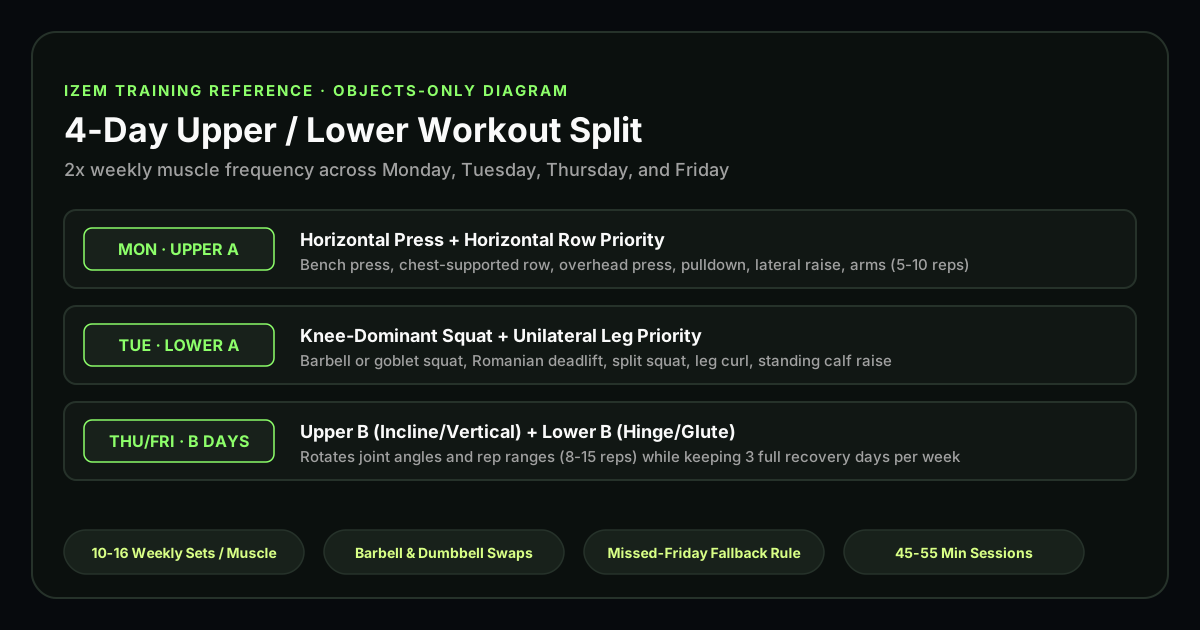
Why rotate A and B days instead of repeating the same workout?
Repeating heavy flat barbell bench presses and floor deadlifts twice every week wears down your shoulders and lower back. The cleanest 4-day upper/lower routines bias Upper A and Lower A toward horizontal pressing and knee-dominant squatting, then bias Upper B and Lower B toward incline/vertical pressing and hip-hinge work [2].
Monday (Upper A) & Tuesday (Lower A) workout tables
Warm up with 2 to 3 lighter ramp-up sets on the first compound movement of the day. Leave 1 to 2 Reps in Reserve (RIR) on working sets so you can add repetitions or load next week.
| Session & Order | Exercise | Sets × Reps | Rest | Dumbbell / Busy-Gym Swap |
|---|---|---|---|---|
| Upper A · 1 | Barbell or Flat Dumbbell Bench Press | 3 × 6 to 8 | 2.5-3 min | Converging Machine Chest Press |
| Upper A · 2 | Chest-Supported Row or Barbell Row | 3 × 8 to 10 | 2 min | One-Arm Bench-Supported Dumbbell Row |
| Upper A · 3 | Seated Dumbbell Shoulder Press | 3 × 8 to 10 | 2 min | Standing Barbell or Landmine Overhead Press |
| Upper A · 4 | Lat Pulldown or Pull-Up | 3 × 8 to 12 | 2 min | Assisted Pull-Up or High-Pulley Kneeling Pulldown |
| Upper A · 5 | Dumbbell Lateral Raise + Incline Curl (Superset) | 3 × 12 to 15 | 60 sec | Cable Lateral Raise + EZ-Bar Curl |
| Lower A · 1 | Barbell Back Squat or Hack Squat | 3 × 6 to 8 | 3 min | 45° Leg Press or Heavy Goblet Squat |
| Lower A · 2 | Dumbbell or Barbell Romanian Deadlift | 3 × 8 to 10 | 2-2.5 min | 45° Loaded Back Extension |
| Lower A · 3 | Dumbbell Bulgarian Split Squat | 3 × 8 to 10 / leg | 90 sec | Reverse Lunge or Single-Leg Press |
| Lower A · 4 | Seated or Lying Leg Curl | 3 × 10 to 15 | 75 sec | Dumbbell Lying Hamstring Curl |
| Lower A · 5 | Standing Calf Raise + Hanging Knee Raise | 3 × 12 to 15 | 60 sec | Leg Press Calf Press + Dead Bug |
Thursday (Upper B) & Friday (Lower B) workout tables
After resting on Wednesday, Thursday and Friday shift the primary angle of pull and push while prioritizing the posterior chain on leg day.
| Session & Order | Exercise | Sets × Reps | Rest | Dumbbell / Busy-Gym Swap |
|---|---|---|---|---|
| Upper B · 1 | 30° Incline Dumbbell or Barbell Press | 3 × 8 to 10 | 2-2.5 min | Incline Machine Press |
| Upper B · 2 | Neutral-Grip Lat Pulldown or Chin-Up | 3 × 8 to 10 | 2 min | Dumbbell Pullover + High-Rep Row |
| Upper B · 3 | Seated Cable Row (Wide or Mid Grip) | 3 × 10 to 12 | 90 sec | 30° Incline Prone Dumbbell Row |
| Upper B · 4 | Cable Fly or Deficit Push-Up | 2-3 × 10 to 15 | 75 sec | Flat Dumbbell Fly-Press |
| Upper B · 5 | Rope Face Pull + Overhead Triceps Extension | 3 × 12 to 15 | 60 sec | Rear-Delt Dumbbell Raise + Skull Crusher |
| Lower B · 1 | Trap-Bar or Conventional Deadlift | 3 × 5 to 8 | 3 min | Heavy Barbell or Dumbbell RDL |
| Lower B · 2 | Leg Press or Front Squat | 3 × 10 to 12 | 2 min | Heel-Elevated Dumbbell Goblet Squat |
| Lower B · 3 | Barbell or Dumbbell Hip Thrust | 3 × 10 to 12 | 90 sec | Single-Leg Elevated Glute Bridge |
| Lower B · 4 | Seated Leg Curl + Leg Extension (Paired) | 3 × 12 to 15 | 60 sec | Slider Hamstring Curl + Step-Up |
| Lower B · 5 | Seated Calf Raise + Suitcase Carry | 3 × 12-15 / 40s | 60 sec | Single-Leg Floor Calf Raise + Side Plank |
Interactive 4-Day Upper/Lower Schedule & Missed-Day Builder
Choose your preferred weekly calendar, equipment setup, and whether you have all 4 days available this week or need to compress Thursday and Friday into a single workout.
4-Day Upper/Lower Plan
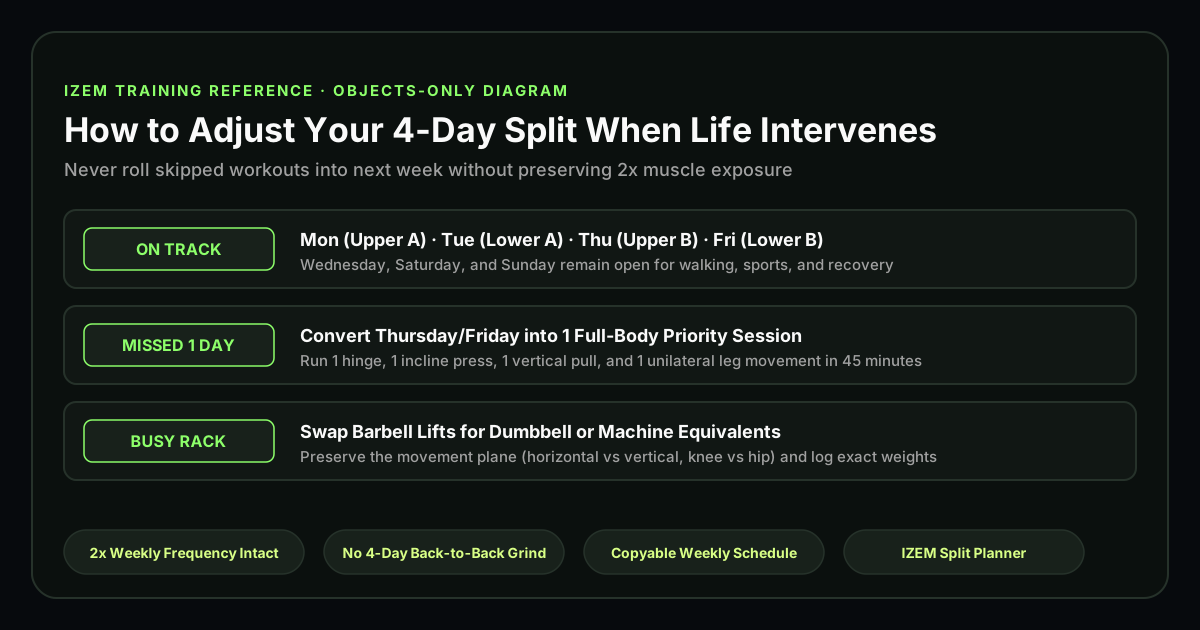
What to do when you miss Friday's Lower B workout
Life rarely respects a rigid 4-day calendar every single week. If a travel day or late meeting wipes out one of your back-half sessions, do not leave your lower body trained only once that week. Convert your final session of the week into a 45-Minute Upper/Lower Hybrid:
- 1. Primary Hinge (from Lower B): Romanian Deadlift or Trap-Bar Deadlift — 3 × 6 to 8
- 2. Primary Incline Push (from Upper B): 30° Incline Dumbbell Press — 3 × 8 to 10
- 3. Primary Vertical Pull (from Upper B): Lat Pulldown or Chin-Up — 3 × 8 to 10
- 4. Unilateral Leg (from Lower B): Walking Lunge or Leg Press — 3 × 10 to 12
- 5. Arm/Shoulder Pair: Lateral Raise + Triceps Extension — 2 × 12 to 15
Need to convert barbell working weights into dumbbell equivalents? Open the Exercise Substitution Library & Load Converter or estimate your training percentages in the 1RM Calculator.
Frequently asked questions
Is a 4-day upper/lower split better than Push/Pull/Legs?
If you can train 4 days per week, an upper/lower split hits every muscle group twice every 7 days. A classic Push/Pull/Legs split requires 6 days per week to achieve that same twice-weekly muscle frequency.
Why does Lower A come right after Upper A on consecutive days?
Because Monday trains chest, back, shoulders, and arms while Tuesday trains quads, hamstrings, glutes, and calves. Only grip and spinal stabilizers overlap, which is why Tuesday starts with squats and places heavy floor deadlifts on Friday after Wednesday's rest day.
How many total sets per muscle group does this 4-day split provide?
Across Monday through Friday, chest, back, quads, and hamstrings each receive 10 to 14 hard working sets—right inside the 10 to 20 weekly set window linked to hypertrophy in resistance-training meta-analyses.
References and primary sources
- Schoenfeld BJ, Ogborn D, Krieger JW. Effects of Resistance Training Frequency on Measures of Muscle Hypertrophy: A Systematic Review and Meta-Analysis. Sports Medicine. 2016;46(11):1689-1697. PubMed 27102172.
- Schoenfeld BJ, Ogborn D, Krieger JW. Dose-response relationship between weekly resistance training volume and increases in muscle mass: A systematic review and meta-analysis. Journal of Sports Sciences. 2017;35(11):1073-1082. PubMed 27433992.
- American College of Sports Medicine. ACSM Position Stand: Progression Models in Resistance Training for Healthy Adults. Medicine & Science in Sports & Exercise. 2009;41(3):687-708. PubMed 19204579.