Watch the video guide
A short IZEM video guide for the decisions in this article.
A Bulgarian split squat is a split squat with your rear foot resting on a bench or other suitable support. The front leg does most of the work as you lower and stand. Use a stable setup, move under control and stop if the exercise causes pain. It's a demanding variation: ACE classifies it as advanced. [1]
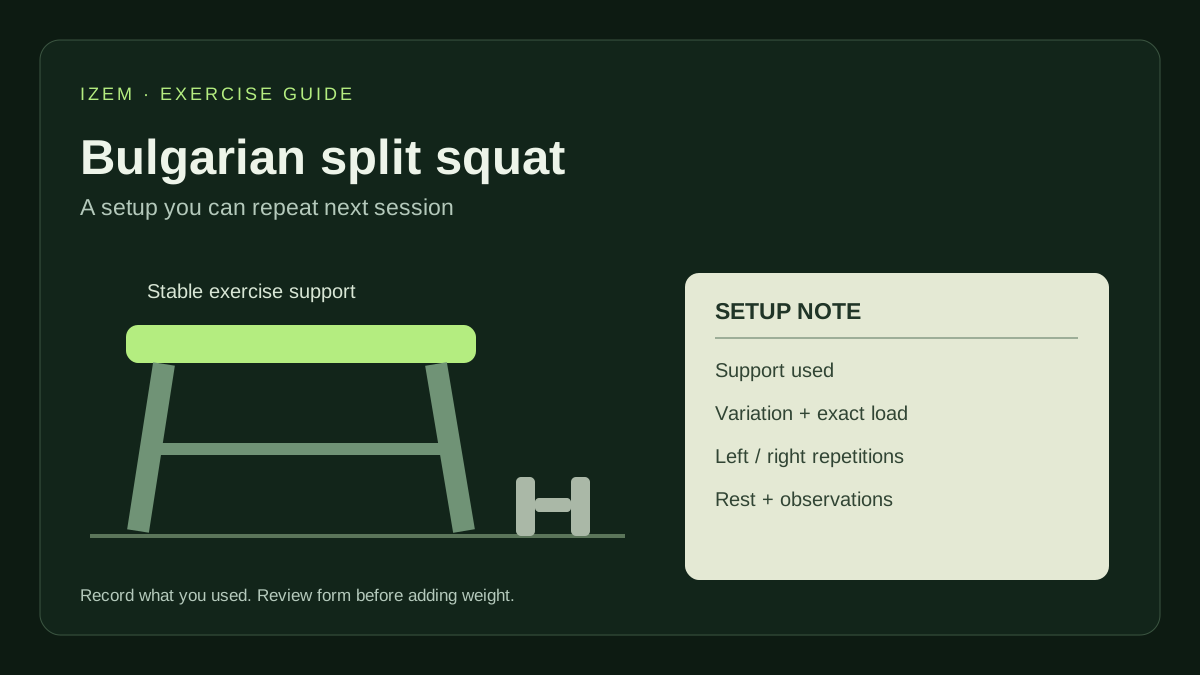
The awkward part can happen before the first repetition: choosing a bench, placing the front foot, and deciding whether to pick up the dumbbells. Changing that setup every week also makes your training log harder to interpret. Eight repetitions today and eight next time are less useful to compare if the exercise has changed along with them.
This guide covers the movement and the decisions around it. The setup note gives you somewhere to record those details, including separate results for each leg.
Educational guidance for healthy adults. If you're new to lifting, have an injury or need help choosing an exercise, work with a qualified fitness professional. Pain during exercise needs attention; a web guide cannot assess its cause.
How to do a Bulgarian split squat
Warm up before lifting. Start without added weight while learning the position, and ask for a technique check if you're unsure. Mayo Clinic advises reducing the load or repetitions when you can't maintain form. [4]
- Set the support behind you. Use a stable exercise bench or suitable box with clear space around it. Face away from it.
- Place the rear foot on the support. Rest the top of that foot on the bench. Put the front foot ahead of you with some width between the legs. ACE starts from a hip-width stance; avoid balancing on one narrow line.
- Lower under control. Bend the front knee and hip, letting the rear knee descend. Keep your trunk controlled and the front foot planted.
- Stand through the front leg. Press into the floor to return. Complete the planned repetitions, then change sides. Keep the descent controlled rather than dropping into the bottom.
ACE illustrates the exercise with a bench or box around knee height. Treat that as a reference, not proof that a particular bench fits you. If the rear-foot position is uncomfortable, stop and review the setup rather than forcing it.
The rear-foot setup and controlled lowering follow the exercise description in NSCA Coach [5]. ACE and NASM also provide movement demonstrations. Use a depth you can control comfortably; don't force a deeper position through pain to match a picture.
When you add dumbbells, record whether the load means one dumbbell or the total of a pair. “10 kg” leaves that question open. “Two 10 kg dumbbells” gives your next session a clear starting point.
What muscles does it work?
The main muscles are the quadriceps and glutes of the working leg. NASM also lists the hamstrings, adductors and muscles that stabilize the hips and trunk. [2]
The rear leg still contributes. In a study of 26 trained men performing the rear-foot-elevated split squat, the lead foot produced most of the measured vertical force. That supports treating it as an exercise focused on the front leg. It doesn't give you a percentage to aim for, or tell you how much muscle you'll gain. [3]
For your log, label the side by the leg on the floor: “left working leg” or “right working leg.” That avoids mixing up the elevated foot with the leg whose repetitions you're recording.
Common problems: what to check before the next set
First identify what stopped the repetition. Losing balance, an awkward rear-foot position and pain are different problems. Writing down the actual interruption is more useful than recording every difficult set as “legs tired.”
| What happened | Next step | Useful note |
|---|---|---|
| You wobble or need to reposition mid-set. | End the set safely. Review the stance without weights; a qualified trainer can help you choose a more stable variation. | Which side, and when balance interrupted the set. |
| The rear-foot position is uncomfortable. | Stop and check the support and placement. Consider a floor split squat instead of forcing the elevated position. | The support you used and what felt uncomfortable. |
| The load pulls you out of position. | Reduce it. NASM identifies excessive weight and loss of postural control as common errors. | The exact load and the last controlled repetition. |
| Your front knee caves inward or the movement becomes uncontrolled. | Stop the set and get a technique check. Don't add weight while the same issue keeps recurring. | The point in the set where control changed. |
| You feel pain during the exercise. | Stop. Seek qualified advice for persistent pain or an injury; don't use this table to diagnose it. | What happened, for discussion with a professional. |
The form checks draw on NASM's common-error list; the pain boundary follows Mayo Clinic's advice to stop an exercise that causes pain. The notes column is an editorial logging aid, not a diagnostic test. [2] [4]
Choose a variation you can repeat
Raising the rear foot is optional in a training program. An ordinary split squat keeps it on the floor. That gives you a different exercise to discuss with your trainer if the elevated version is awkward or beyond your current experience.
A bodyweight Bulgarian split squat removes the added load while you learn the setup. Once you can control the movement and it suits your program, dumbbells provide a way to add resistance. NASM describes holding them at your sides; ACE demonstrates a goblet hold in front of the chest. [1] [2]
Give each version its own name in your log. A bodyweight set, a goblet set and a set with two dumbbells aren't interchangeable entries. If you change the support or variation, mark that change before comparing repetitions with last week.
Barbells and specialized equipment introduce more setup decisions. They aren't a required next step. Keep the variation that fits your training and equipment rather than changing it simply because a heavier version appears in a video.
Where it belongs in a workout
Decide what job it has in the session. If your program already includes a single-leg exercise, discuss whether the Bulgarian split squat should replace that slot. Adding it on top creates extra work, even if the exercise list grows by only one line.
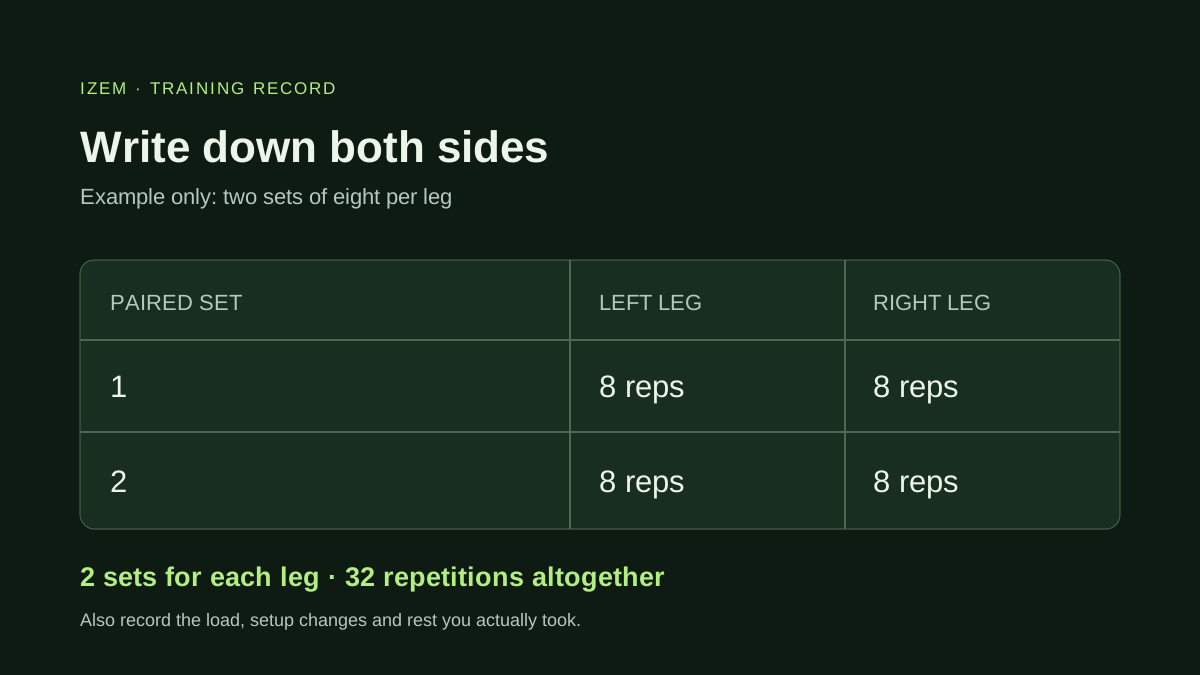
Allow time for both sides. Suppose your existing program calls for two sets of eight repetitions per leg. A clear log would read:
- Paired set 1: left 8, right 8.
- Paired set 2: left 8, right 8.
That is two completed sets for each leg, or 32 repetitions across both legs. It isn't four sets per leg. Record the rest you actually took as well; this example doesn't prescribe a rest interval or an appropriate workload.
If one side completes fewer controlled repetitions, write down the difference. Repeating the target number on paper won't explain what happened. For an ongoing log, use the progressive overload tracker. To check whether the whole session fits your available time, see how many exercises to put in a workout.
Keep a setup note for next time
Fill in what you used and what you completed. The tool formats your note; it doesn't choose weights, judge form or prescribe progression. Entries stay in this page's memory until you reload or leave. Copy the text somewhere you control if you want to keep it.
Bulgarian split squat setup note
A few questions that come up
Why do Bulgarian split squats feel so hard?
You're concentrating much of the work on the front leg while maintaining a split stance. The setup adds a balance demand. Check whether the set ended because the working leg was fatigued or because you couldn't keep the position. Record what interrupted it before changing the load.
Are they for glutes or quads?
Both contribute. You don't need to label every set “glute” or “quad” to keep a useful record. Note the variation, load and repetitions. Feeling one area more strongly doesn't measure how much another muscle worked.
What's the difference from a lunge?
In this split squat, the feet stay in the same positions through the set and the rear foot is elevated. A stepping lunge involves moving into and out of the stance. Record them as separate exercises when you switch between them.
Can I do them every day?
Don't assume one exercise needs daily practice or hard daily sets. Consider your whole lower-body program and recovery. Mayo Clinic's general guidance advises avoiding training the same muscles on consecutive days. [4]
Plan the rest of the session
Keep the setup note alongside the workout, including any variation change. Then look at the other exercises and the time available. The free workout-plan generator can help organize a session around your goals, equipment and schedule. It doesn't receive this note or assess your Bulgarian split squat technique.
IZEM combines workout planning with progress review and accountability. If you want that ongoing support, see how IZEM's coaching works. For a hands-on form check, work with a qualified fitness professional.
Sources and editorial notes
[1] American Council on Exercise. Bulgarian Split Squat exercise library. Used for the exercise classification, stance and goblet variation.
[2] National Academy of Sports Medicine. Bulgarian Split Squat. Used for the movement outline, muscles and common form errors.
[3] Helme M, Emmonds S, Low C. Is the Rear Foot Elevated Split Squat Unilateral? An Investigation Into the Kinetic and Kinematic Demands. Journal of Strength and Conditioning Research, 2022;36(7):1781–1787. DOI: 10.1519/JSC.0000000000003727. This study's trained male sample and protocol do not establish an individual prescription.
[4] Mayo Clinic Staff. Weight training: Do's and don'ts of proper technique, January 21, 2026. General guidance on form, pain and recovery.
[5] Cathrall C. NSCA Coach, volume 3, issue 1, page 41. Used only for its rear-foot-elevated split squat description; the article's basketball injury-screening protocols are not recommendations for readers of this guide.
Sources checked October 10, 2026. The setup note and logging examples are IZEM editorial tools. They have not been validated as a technique assessment or medical screening method.