Watch the video guide

A short IZEM video guide for the decisions in this article.
Quick conversion rule: Subtract your Reps in Reserve from 10 to get your Rate of Perceived Exertion (RPE) [1]. Finishing a set with 2 Reps in Reserve equals RPE 8; finishing with 1 Rep in Reserve equals RPE 9; reaching technical failure with 0 Reps in Reserve equals RPE 10.
Educational fitness and nutrition information for healthy adults. Nothing on this page is medical advice or a clinical prescription. Stop any movement that causes sharp pain or dizziness, and consult a physician, physical therapist, or registered dietitian for medical or injury guidance.
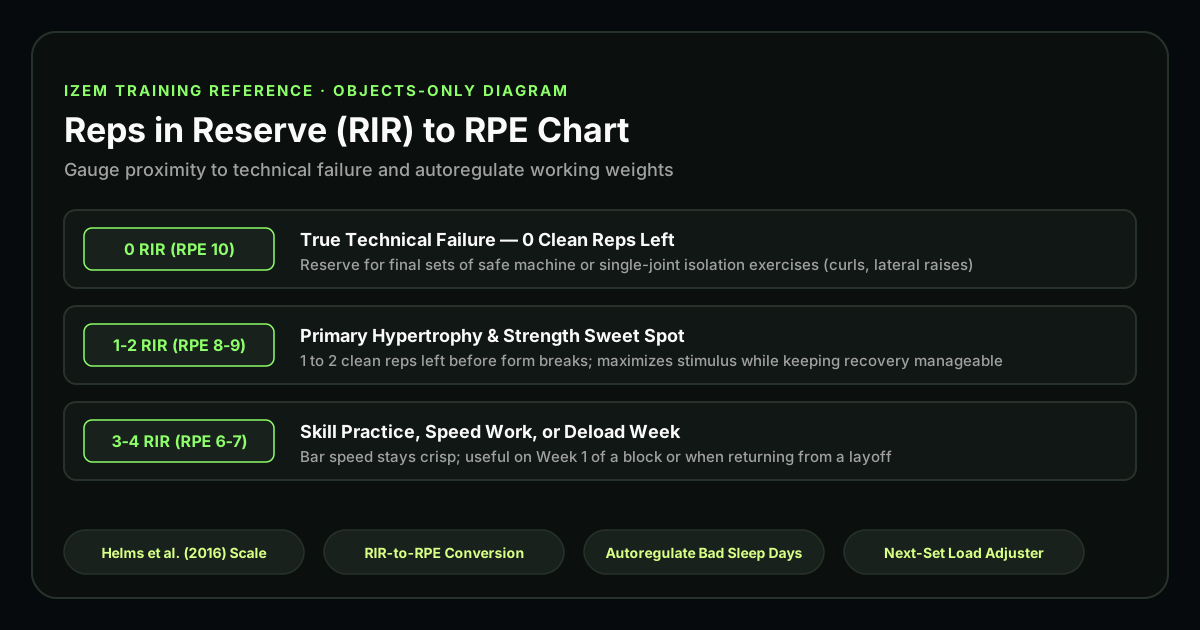
Complete RIR to RPE conversion chart
Fixed percentages of your one-rep max assume your strength is identical on a rested Saturday morning and after a stressful Tuesday workday. Validated by Helms et al. (2016) and Zourdos et al. (2016), the RIR scale lets you autoregulate your weight on the bar based on how many clean repetitions remain at the end of the set [1] [2].
| RIR (Reps in Reserve) | RPE Equivalent | Bar Speed & Physical Cue on Final Rep | Best Use in a Workout Plan |
|---|---|---|---|
| 0 RIR | RPE 10 | Grinding concentric speed; another repetition would fail or break safe posture. | Final set of single-joint isolation or cable/machine lifts (curls, lateral raises, leg curls). |
| 1 RIR | RPE 9 | Clear bar-speed slowdown on the final rep; confident you had exactly 1 clean rep left. | Top hypertrophy working sets on dumbbells, machines, rows, and final compound sets [3]. |
| 2 RIR | RPE 8 | Last rep noticeably slower than rep 1, but posture stays locked; 2 reps left in the tank. | Default target for multi-joint compound sets (squats, RDLs, presses, split squats) [1]. |
| 3 RIR | RPE 7 | Smooth, brisk bar speed with moderate effort; 3 clean repetitions remaining. | Heavy barbell strength work, Week 1 of a new block, or returning after a week off. |
| 4+ RIR | RPE 6 or below | Fast, effortless repetitions with minimal local fatigue. | Warm-up sets, technique practice, or active recovery sessions. |
Interactive RIR Autoregulation & Next-Set Load Adjuster
Enter the weight and reps you just completed, your actual RIR at the end of the set, and your target RIR for the next set. The tool calculates whether to keep, raise, or lower the weight.
Next-Set Load Recommendation
Why you shouldn't take every exercise to 0 RIR
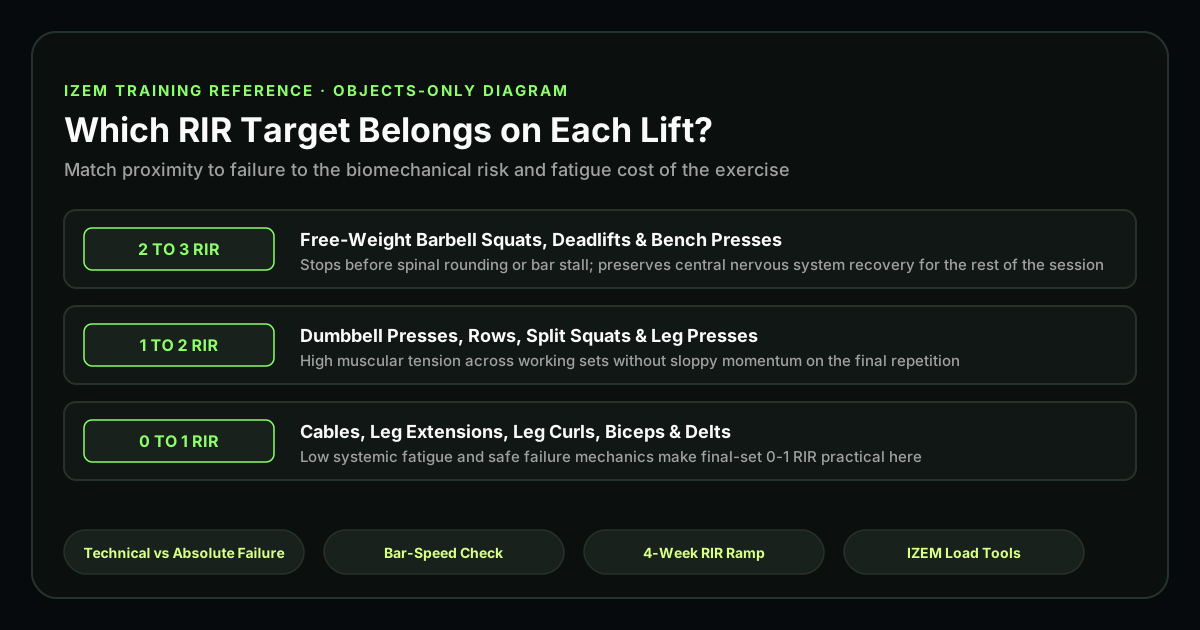
Meta-analyses comparing training to failure (0 RIR) against stopping 1 to 3 reps short of failure show similar muscle growth when weekly set volume is matched, while 0 RIR causes substantially greater neuromuscular fatigue and longer recovery times [3]. Match your RIR target to the exercise:
- Barbell squats, deadlifts, and bench presses (2 to 3 RIR): Taking Set 1 of squats to absolute failure spikes central fatigue and forces you to strip plates off the bar for Sets 2 and 3. Stopping with 2 clean reps in reserve lets you complete all three sets with the same heavy working weight.
- Dumbbell presses, rows, and lunges (1 to 2 RIR): Independent stabilization makes true 0 RIR awkward to spot, so stopping 1 to 2 reps before form breakdown keeps tension on the target muscle.
- Cables, machines, and single-joint isolation (0 to 1 RIR on the final set): Because lateral raises, curls, pressdowns, and leg curls carry low spinal and systemic fatigue, taking the final set to 0–1 RIR is a safe way to verify that you aren't underestimating your effort.
How to calibrate your RIR when you're not sure
Studies show that lifters are most accurate at judging RIR when a set runs between 6 and 10 repetitions and ends within 0 to 2 reps of failure [2]. When a set goes past 15 repetitions, burning discomfort often tricks people into stopping with 4 or 5 reps still in the tank. Once every three to four weeks, take the final set of a safe machine or cable exercise (like a seated cable row or chest press machine) to technical failure (0 RIR) while counting the reps after the bar starts slowing down. That teaches you exactly what 2 RIR and 1 RIR feel like.
Combine this chart with our One Rep Max (1RM) Calculator and Progressive Overload Tracker Template to log both weight and RIR each week.
Frequently asked questions
What is the difference between technical failure and absolute failure?
Technical failure (0 RIR for safe programming) is the point where you cannot complete another repetition without losing target joint alignment, bouncing the weight, or shifting the load onto other muscles. Absolute failure is when the weight physically stops moving regardless of form.
Should RIR stay the same across all 4 weeks of a training block?
Many structured programs start Week 1 at 2 to 3 RIR while you adapt to the movement volume, move to 1 to 2 RIR in Weeks 2 and 3, and finish Week 4 at 1 RIR (with 0 RIR on isolation final sets) before resetting.
How does RIR relate to percentage of 1RM?
Each repetition in reserve corresponds to roughly 2.5% to 3% of your 1RM. For example, a weight you can lift for 8 reps at 0 RIR (~78-80% 1RM) becomes an 8-rep set at 2 RIR when loaded around 73-75% 1RM.
References and primary sources
- Helms ER, Cronin J, Storey A, Zourdos MC. Application of the Repetitions in Reserve-Based Rating of Perceived Exertion Scale for Resistance Training. Strength and Conditioning Journal. 2016;38(4):42-49. PubMed 27531969.
- Zourdos MC, Klemp A, Dolan C, et al. Novel Resistance Training-Specific Rating of Perceived Exertion Scale Measuring Repetitions in Reserve. Journal of Strength and Conditioning Research. 2016;30(1):267-275. PubMed 26049792.
- Refalo MC, Helms ER, Trexler ET, Hamilton DL, Fyfe JJ. Influence of Resistance Training Proximity-to-Failure on Skeletal Muscle Hypertrophy: A Systematic Review with Meta-Analysis. Sports Medicine. 2023;53(3):649-665. PubMed 36334240.