Watch the video guide
A short IZEM video guide for the decisions in this article.
For two or three reliable lifting days, start by considering full-body training. With four, upper/lower is a useful starting point. Five days can accommodate an upper/lower and push/pull/legs hybrid; six can fit push/pull/legs twice. These are scheduling suggestions, not a ranking of which routine builds the most muscle.
A workout split divides your resistance training between sessions. Full body, upper/lower and push/pull/legs tell you where the work goes. You still need to choose the exercises, sets and effort within each session.
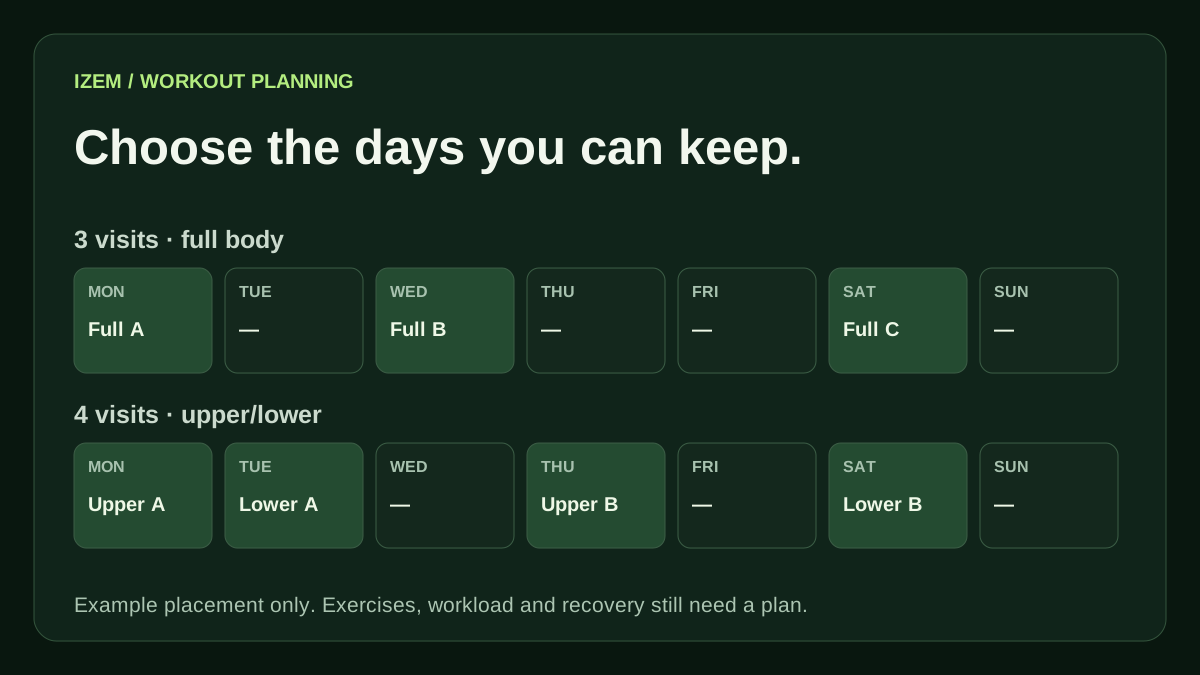
Start with an ordinary week, including the late meetings and the time it takes to get to the gym. If three visits are dependable and a fourth depends on leaving work early, compare a three-day routine before committing to four. The calendar below shows what that choice changes.
This guide is for healthy adults planning resistance training. The examples and calendar are educational planning aids, not individualized exercise prescriptions. Get qualified advice for an injury, pain during exercise, or a health condition that affects training.
Compare the main workout splits
Choose the row that matches the visits you can usually make. The weekly examples below show the tradeoffs in more detail.
| Reliable lifting days | Structure to consider | Main scheduling tradeoff |
|---|---|---|
| 2 | Full body twice | Broad coverage in both visits, but each session needs a manageable exercise list. |
| 3 | Full body three times | Each visit includes upper- and lower-body work. Consecutive available days need more care with the program. |
| 4 | Upper/lower twice | A clear division of work, provided four visits are genuinely available. |
| 5 | Upper, lower, push, pull, legs | Five appointments, potentially shorter sessions; total workout time depends on their length. |
| 6 | Push/pull/legs twice | A repeating sequence with little spare room in the calendar. |
In these examples, an upper session includes upper-body pushing and pulling. A lower session focuses on the lower body. Push and pull separate upper-body pressing from upper-body pulling, while legs is the lower-body session. These labels are broad: the exercises still determine what gets trained.
A body-part split gives an area its own day, such as chest on Monday and back on Tuesday. Miss that day and you may lose its only dedicated session for the week, although other exercises can still involve those muscles. Check the exercise list rather than assuming a missed label means no training at all.
Check the fit against your calendar
Select your available weekdays and minutes per visit. Mark a day that often falls through to see what one cancellation removes from each schedule. For a four-day selection, the tool also compares a three-day alternative.
The numbers under each calendar count sessions that include a broad focus. An upper session counts once for pushing and once for pulling. They are not set counts: three full-body visits don't automatically provide more training than two upper and two lower visits. The actual exercises and workload decide that.
When an alternative uses fewer visits, the tool first leaves out the unreliable day where possible. It then favors arrangements without adjacent sessions sharing a broad focus, followed by more even spacing. Sunday and Monday count as neighbors. This is a scheduling rule, not a recovery calculation or a medically validated recommendation.
Calendar-fit check
Runs in your browser. The planner does not save or send your selections.
Two days: make both visits count
Example week: Monday — Full body A. Thursday — Full body B.
There are only two visits to distribute the work across, so a full-body format deserves an early look. Splitting those visits into one upper and one lower day leaves each broad area with only one scheduled session. That may be a deliberate choice in an individual program, but it isn't the same weekly pattern as two full-body sessions.
ACSM's 2026 guidance emphasizes regular resistance training and working all major muscle groups at least twice a week. Two full-body visits can provide places to do that; the labels themselves do not prove that your exercise choices meet the guidance. [1]
A and B can use different exercises. There is no need to squeeze your entire exercise list into both visits. Our exercise-count and session-time guide helps you check how the working sets, rest and setup fit.
Only available Saturday and Sunday? Don't quietly treat that as the same arrangement as Monday and Thursday. The calendar flags adjacent days, including Sunday followed by Monday in a repeating week. A qualified trainer can help distribute the work when your available days are clustered.
Three days: full body, or a rolling upper/lower routine
Example week: Monday — Full body A. Wednesday — Full body B. Saturday — Full body C.
This gives you three places to include upper- and lower-body work. A, B and C needn't contain the same exercises or the same workload. Avoid interpreting “full body” as “every exercise I know, every time.”
For comparison, a three-day upper/lower rotation can run across two weeks:
| Week | Monday | Wednesday | Saturday |
|---|---|---|---|
| 1 | Upper | Lower | Upper |
| 2 | Lower | Upper | Lower |
Over those two weeks, each half has three sessions. It does not train each half twice every calendar week. That distinction is easy to miss when looking at just the first Monday-to-Sunday schedule.
A three-day push/pull/legs routine distributes its three focus areas differently again: one dedicated visit for each. It should not inherit the claims made about a six-day version simply because both are called PPL. Compare the actual exercise work and frequency, not just the name.
Four days: upper/lower with room between the repeats
Example week: Monday — Upper A. Tuesday — Lower A. Thursday — Upper B. Saturday — Lower B.
This arrangement puts two upper and two lower sessions on the calendar. Monday and Tuesday are consecutive visits, but their main focus differs. You still need to consider overlapping exercises and how you feel; a lower session can involve more than the legs, for example.
Check the whole appointment before choosing four days. A 45-minute workout plus a 15-minute trip each way takes 75 minutes before changing clothes. Put that time in the calendar, not just the lifting.
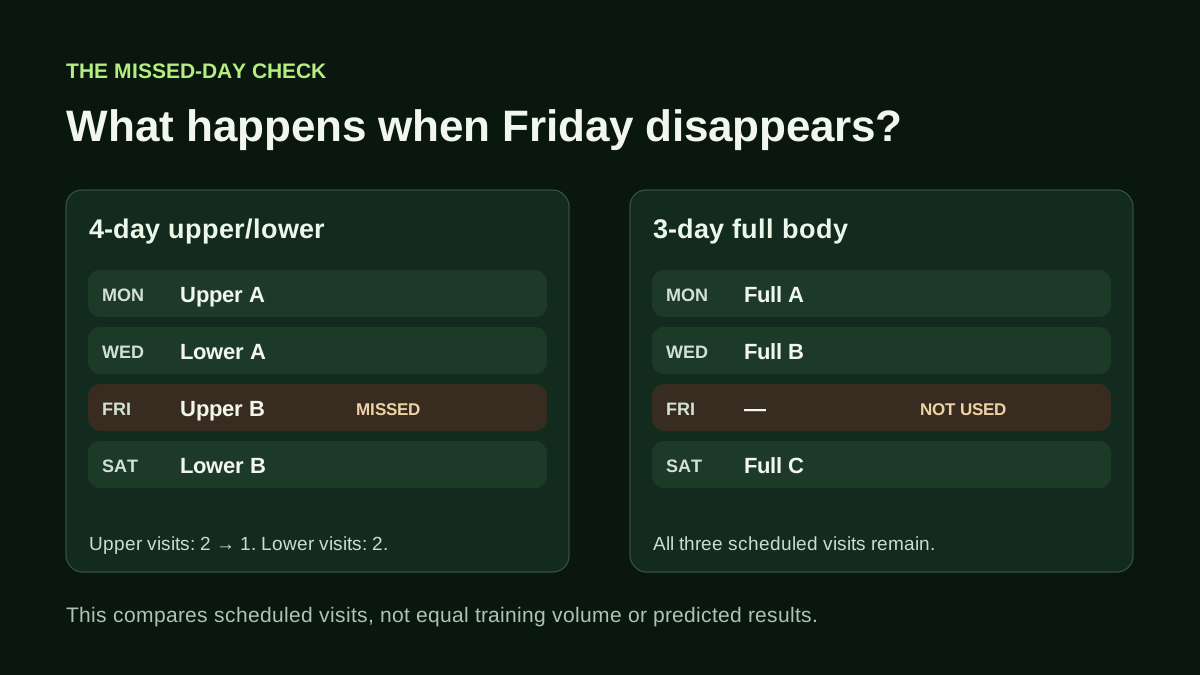
Here is the earlier example in more detail. Keep Monday, Wednesday and Saturday fixed, with Friday uncertain:
| Plan | Monday | Wednesday | Friday | Saturday |
|---|---|---|---|---|
| Four-day upper/lower | Upper A | Lower A | Upper B | Lower B |
| Three-day full body | Full body A | Full body B | No lifting scheduled | Full body C |
Lose Friday and the first plan drops to one upper and two lower sessions that week. The second keeps its scheduled visits. That doesn't prove the second plan produces better results: the plans may contain different exercises and amounts of work. It shows exactly which part of the schedule depends on Friday.
Five days: combine two familiar formats
Example week: Monday — Upper. Tuesday — Lower. Thursday — Push. Friday — Pull. Saturday — Legs.
The first upper session includes pressing and pulling, followed later in the week by separate push and pull sessions. The two lower-body visits sit on Tuesday and Saturday.
Decide how much work belongs in the week before dividing it between these sessions. Keeping an already full upper-body workout and adding separate push and pull days increases the workload. Splitting the same exercises and sets between more visits is a different decision.
Compare the five-day option with four-day upper/lower in the tool. Five 30-minute visits reserve 150 minutes of workout time; four 45-minute visits reserve 180. Neither total measures training quality. It does show why more training days needn't mean more time lifting, even though they mean another appointment and possibly another trip.
Six days: check the commitment before choosing PPL
Example week: Monday — Push A. Tuesday — Pull A. Wednesday — Legs A. Friday — Push B. Saturday — Pull B. Sunday — Legs B.
Thursday has no lifting session in this example. Sunday does, followed immediately by Monday's push session in the next week. Check that repeating pattern, including any exercises that overlap. If Sunday is reserved for family or another activity, choose a different arrangement rather than treating it as a day you should somehow find.
At 45 minutes per visit, six visits reserve 270 minutes for the workouts alone, compared with 180 minutes for four. Travel and other preparation add to both totals. That simple calculation is worth doing before worrying about the perfect split name.
Six days is an option, not a requirement. Choose it because the workload and appointments suit you, rather than because the next number up looks like progress.
Is there a best workout split for muscle gain?
A 2024 meta-analysis by Ramos-Campo and colleagues combined 14 studies with 392 participants. It found no significant difference in the measured strength and muscle-growth outcomes between split and full-body routines when training volume was equated. [2]
That last condition matters. The finding does not make two arbitrary programs equivalent, and it does not establish a universal winner among the calendars on this page. Compare the work each program asks you to complete, then choose a structure that fits your availability and preferences. If your primary goal is shifting body composition—building muscle while shedding fat—consult our body recomposition guide to balance training stimulus with calibrated nutrition.
What to check besides the number of days
Once the days fit, check what you intend to do in them. Working sets, exercise choices, effort, rest and progression still need planning. A tidy timetable cannot tell you whether that workload is appropriate.
Session length matters, too. Two 30-minute full-body visits and two 75-minute visits have the same frequency but different time budgets. The calendar won't claim that a session fits just because you've selected 30 minutes. Use the exercise-count guide once you've decided what the workout contains.
Equipment may change the practical choice. Moving between several busy stations takes time. An upper/lower day could reduce the range of equipment you need, but only the actual exercise list tells you whether that is true. See the exercise-substitution guide when a station is unavailable.
Also leave room for activity outside lifting. CDC guidance includes aerobic activity as well as muscle strengthening. A strength-training split is only one part of an active week, not a reason to remove every walk or other activity you enjoy. [3]
When a workout gets missed
Look at the session you missed and the next day you can actually train. Does the cancellation remove an area's only dedicated session, or one of several opportunities that week? Don't squeeze several hard sessions together just to make the calendar look complete.
For a one-off disruption, the right adjustment depends on what you missed, the remaining workload and your recovery. The missed-workout planning guide covers that separate decision. This calendar deliberately doesn't rewrite your exercise prescription after a missed visit.
If Friday keeps disappearing, take it out of the normal plan and compare the remaining days. A more complicated split won't create an extra evening.
Build the workouts after choosing the week
Choose a base week and write down the days. Then fill each session with exercises and a workload suited to your experience and goals. Keep a record of what you complete so later changes respond to your actual training rather than a new split you saw online.
The free workout-plan generator is the next planning step. It is a separate tool: this calendar does not automatically transfer your selected split or promise an identical generated schedule. Check the output against the days and constraints you've chosen here.
For ongoing support, IZEM. Your AI Personal Trainer brings personalized workout planning together with progress review, schedule and equipment adaptation, and accountability through two-way voice calls. It is coaching software, not a substitute for qualified medical care. Learn how IZEM's coaching works.
Sources
[1] American College of Sports Medicine. 2026 resistance-training guidance, published March 17, 2026. Used for general participation and muscle-group frequency guidance, not as proof that these example calendars are optimal.
[2] Ramos-Campo DJ and colleagues. Efficacy of Split Versus Full-Body Resistance Training on Strength and Muscle Growth: A Systematic Review With Meta-Analysis. Journal of Strength and Conditioning Research, 2024;38(7):1330–1340. DOI: 10.1519/JSC.0000000000004774.
[3] Centers for Disease Control and Prevention. Adding Physical Activity as an Adult, updated December 4, 2025. General activity guidance; individual needs may differ.