A practical starting list is 3–6 strength exercises per workout. This is a planning range, not a scientifically established optimum. A short session may use fewer; a longer session or a specialized program may use more. Keep the exercises your program needs, then check their sets, rest periods and place in the training week.
Four exercises can be a substantial workout. Four exercises with three working sets each means twelve sets before you count warm-ups. Adding another movement changes both the training work and the time you need. That is why a useful answer needs more than a number.
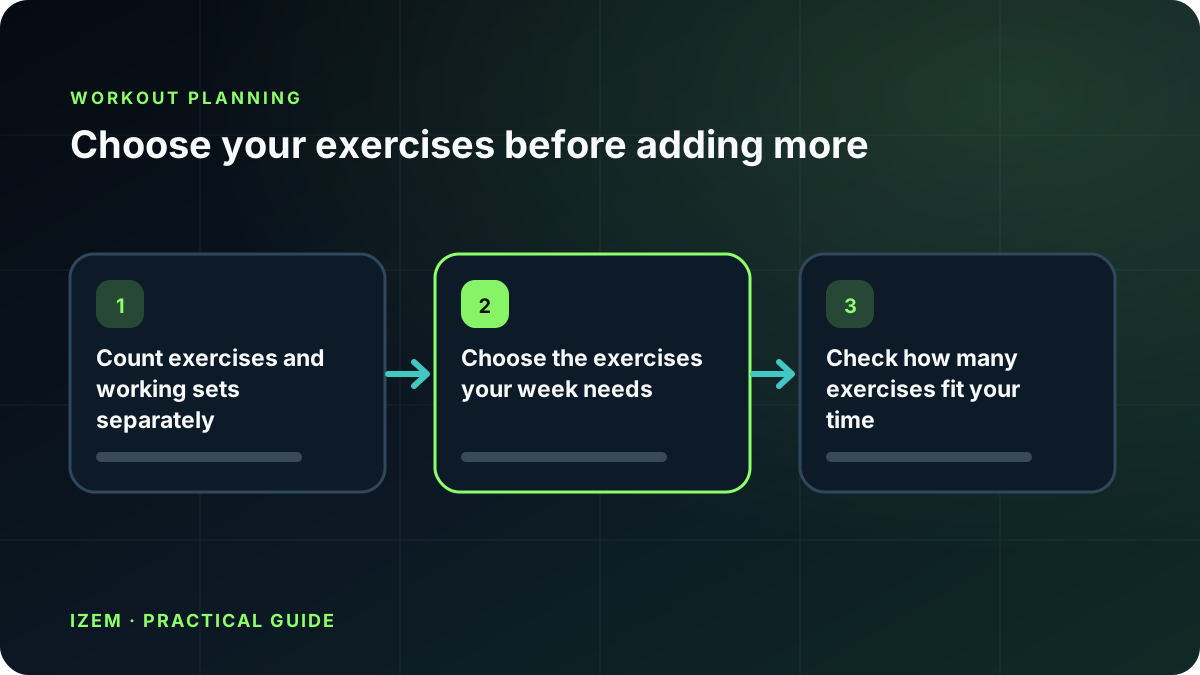
Count exercises and working sets separately
An exercise is a movement you put in the plan, such as a leg press or a seated row. A set is one group of repetitions of that movement. Three sets of rows still count as one exercise.
Warm-up sets take time, but keep them separate from your working-set total. For unilateral movements, a set may include both sides; budget enough time for both. Otherwise, a split squat can look much quicker on paper than it feels in the gym.
| Session | Exercises | Working sets | What changes |
|---|---|---|---|
| Four movements, three sets each | 4 | 12 | More sets of each selected movement |
| Six movements, two sets each | 6 | 12 | More exercise changes and a wider selection |
| Six movements, four sets each | 6 | 24 | Twice the sets, with a larger time commitment |
These sessions are not automatically equivalent. They can train different muscles and use different loads or effort levels. Count the work first, then ask what each movement contributes.
Choose the exercises your week needs
Start with the purpose of today's session. A full-body day spreads the work across more areas. An upper-body or lower-body day narrows the focus. A strength-focused session may spend much of its time on a few priority lifts.
- Keep the priority movements. Identify the exercises your program relies on for its main goal.
- Check coverage across the week. Look for muscle groups or movement tasks that the rest of the schedule misses.
- Question duplicate work. Give each extra exercise a reason to be there before adding it.
- Budget for rest and setup. Leave enough time to complete the planned work without rushing between sets.
Two similar movements can both belong in a program. The question is whether they serve a useful purpose. Three chest variations might be reasonable on a focused day, but they are harder to justify if your short full-body session leaves no time for lower-body work.
The 2026 ACSM position stand supports progressive resistance training for healthy adults and highlights the importance of training volume, load and other program variables. It does not establish one ideal exercise count for every workout. Major muscle groups should be trained across at least two days a week; how you distribute that work depends on the program.
Check how many exercises fit your time
This calculator estimates time capacity for straight sets with the same set count and timing for each exercise. It does not decide how much training you need. Change the defaults to match your actual session.
12 working sets; estimated duration 39 minutes, leaving 6 minutes.
This is time capacity, not a training target. Follow your program and leave room for delays.
How the estimate works
Time = reserved minutes + exercises × [sets × set duration + (sets − 1) × rest] + (exercises − 1) × between-exercise time.
The model counts rest between working sets, with recovery between exercises included in the changeover allowance. It assumes straight sets, not circuits or supersets. Different set counts, longer ramp-up sets or crowded equipment can change the result considerably.
The calculator runs in this page. It does not save or send your entries.
Workout examples by session type
These are illustrative exercise lists, not complete training prescriptions. Choose familiar movements you can perform comfortably, and use the sets, repetitions and loads appropriate to your program.
A short full-body session: three exercises
One possible list is a leg press, a dumbbell press and a seated row. This keeps equipment changes limited and includes lower-body, pushing and pulling work. Other sessions in the week would need to fill the remaining coverage, including posterior-chain work. A short day does not have to carry the entire program.
A fuller full-body session: four or five exercises
A squat variation, a hip-hinge variation, a press and a row give the session four distinct jobs. A fifth movement, such as core work, can fill a planned gap if there is time. Learning an unfamiliar hinge or squat may require coaching and more warm-up time than the calculator's defaults allow.
An upper-body session: four exercises
A press, a row, a pulldown and an arm exercise make a focused example. Four exercises at three working sets each total twelve sets. Whether another exercise belongs depends on the rest of the week's plan, rather than a rule that every upper-body day needs six movements.
A lower-body session with a clear purpose
A squat or leg-press variation, a familiar hip hinge, a leg curl and a calf raise make a four-exercise example with different roles. Your program may use another selection. Keep the priority lift first if improving that lift is the session's main job, and allow for the warm-up and recovery it needs.
A 45-minute workout on paper
Reserve eight minutes for warm-up and other tasks. Each of four exercises has three working sets lasting 45 seconds, with two minutes between sets. Allow two minutes between exercises.
The estimate is 8 + 4 × (2.25 + 4) + 3 × 2 = 39 minutes. Adding a fifth exercise makes it 47.25 minutes. That extra movement no longer fits the 45-minute window under these assumptions.
Keep the six-minute buffer. If a session regularly overruns, update your estimates or review the exercise list instead of quietly dropping warm-ups or rushing the planned rest.
For muscle growth, check the weekly work too
Exercise count alone cannot tell you whether a muscle gets enough work. Record which exercises train it, how many working sets you perform, and how the sessions are distributed.
The ACSM review found that higher weekly volume, including at least ten sets per muscle group per week in its summary, enhanced hypertrophy. Those findings concern weekly volume, rather than sets in a single workout. They do not establish a minimum everyone must reach to benefit. The organization's plain-language guidance also stresses individualization and consistency.
Do not count twelve total session sets as twelve sets for every muscle. Presses, rows and leg exercises distribute the work differently. Compound movements also involve several muscles, so a simple log needs context.
If the plan already covers the week and your priority exercises are progressing, adding more variations may just make it harder to finish. A 2022 systematic review of exercise variation supported purposeful selection and cautioned against redundant exercises and excessive random changes. Its eight included studies involved young men, which limits how broadly its findings can be applied.
Use the free progressive overload tracker to compare completed work across sessions. If equipment availability is the problem, the busy-machine substitution guide helps you review alternatives without piling another exercise onto the day.
Common questions about exercise count
Are four exercises per workout enough?
They can be. Four exercises with several working sets can take most of a session. Check whether they serve the goal and fit into a week that covers the muscles you intend to train. The number alone cannot confirm that a plan is complete.
How many exercises should a beginner do?
Start with a short list of familiar movements you can learn and repeat. Three or four may be manageable in a short session; the wider 3–6 planning range leaves room for a longer full-body workout. There is no need to add complexity just to match someone else's exercise count.
How many sets should I do per workout?
Use the sets specified by your program, then add them up. Four exercises at two sets each gives eight working sets; four at three sets gives twelve. Those totals describe the session, but they do not prescribe the right dose for your goal or each muscle.
Are eight or ten exercises too many?
There is no universal cutoff. A circuit with brief stations differs from ten loaded strength exercises with multiple working sets. If the final movements routinely get skipped, the session overruns, or technique deteriorates, review the plan rather than treating a longer list as progress.
Should I change exercises every workout?
A stable selection makes it easier to learn movements and compare sessions. Change exercises when there is a program reason, an equipment problem, or a need for professional guidance about discomfort. Randomly changing the list makes it harder to tell what improved.
Turn the exercise list into a training week
Use IZEM's free workout-plan generator to choose your goal, equipment, experience, training days and session length. Then check whether the resulting plan fits your schedule and abilities.
Build a free workout planFree to use in your browser. No sign-up required.
Watch the video guide
A short IZEM video guide for the decisions in this article.
Sources and editorial notes
- ACSM resistance-training position stand, 2026: evidence synthesis on training prescription for healthy adults.
- ACSM's plain-language 2026 guidance: consistency, training goals and individualization.
- Kassiano and colleagues, 2022: systematic review of exercise variation.
Sources checked October 5, 2026. The exercise lists, time equation and calculator examples are IZEM editorial planning aids. The 3–6 starting range is a heuristic, not a result established by these studies.