Watch the video guide
A short IZEM video guide for the decisions in this article.
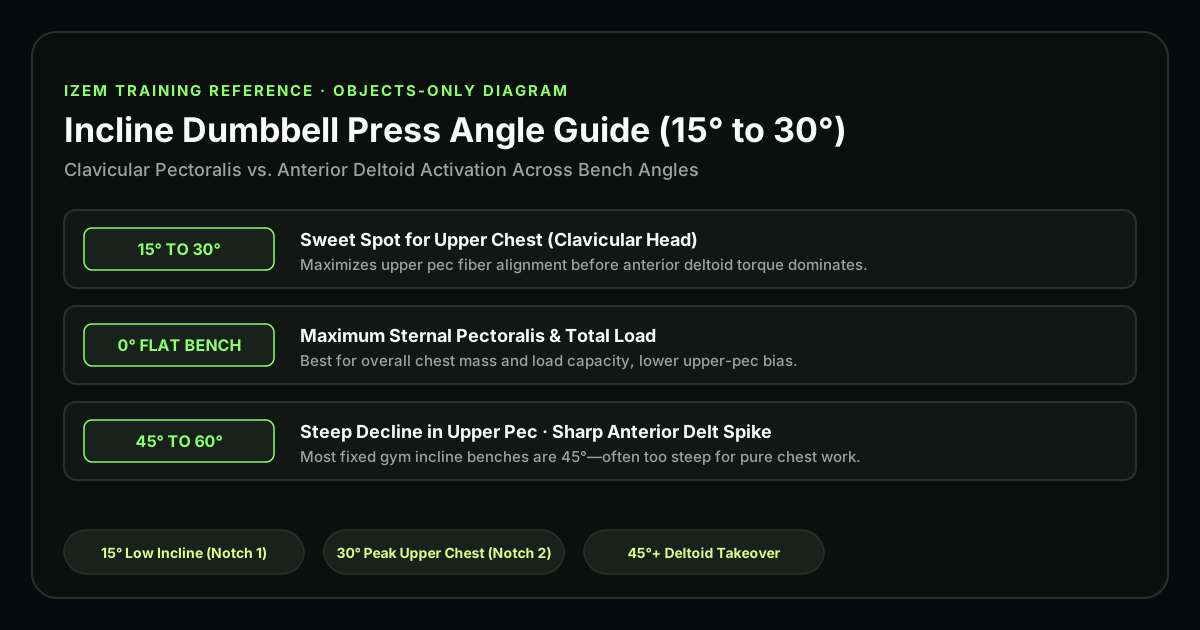
Direct answer: Set your adjustable bench to 15° to 30° (typically the first or second notch above flat) for the incline dumbbell press. Controlled EMG studies show upper-chest (clavicular pectoralis major) activation peaks at 30° and remains high at 15°, whereas raising the bench to 45° or 60° reduces upper-chest recruitment and shifts the work onto the anterior deltoids.
What Happens Between 0° and 60°: The EMG Breakdown
In 2020, Rodríguez-Ridao and colleagues measured surface electromyography (EMG) of the upper chest (clavicular head), middle/lower chest (sternal head), anterior deltoid, and triceps brachii across five bench angles: 0°, 15°, 30°, 45°, and 60° (Rodríguez-Ridao et al., 2020). A companion resistance-trained trial by Lauver et al. reported the same pattern (Lauver et al., 2016).
As the backrest tilts upward, two things happen simultaneously: the humerus path aligns better with the clavicular fibers between 15° and 30°, and shoulder flexion demand climbs steadily. Past 30°, the anterior deltoid takes over so aggressively that upper-chest recruitment actually drops below its 30° peak.
| Bench Angle | Typical Bench Notch | Upper Chest (Clavicular Pec) | Mid/Lower Chest (Sternal Pec) | Front Delt (Anterior Deltoid) | Expected Load vs. Flat DB Press |
|---|---|---|---|---|---|
| 0° (Flat) | Flat (0 clicks) | Moderate baseline | Peak (100% reference) | Low–Moderate | 100% |
| 15° (Low Incline) | 1st notch above flat | High (near-peak) | High (~90%–95%) | Moderate | ~90%–95% |
| 30° (Standard Incline) | 2nd notch above flat | Peak activation | Moderate (~75%–85%) | Moderate–High | ~82%–88% |
| 45° (Steep Incline) | 3rd or 4th notch (or fixed bench) | Drops below 30° | Low | Very High | ~72%–78% |
| 60° (High Incline) | 4th–5th notch | Low–Moderate | Minimal | Dominant (overhead press pattern) | ~65%–70% |
If your gym has a fixed barbell incline station, measure the backrest once with your phone. Most fixed commercial incline benches are welded at 45°, which explains why lifters often prefer adjustable benches with dumbbells for upper-chest hypertrophy (see the IZEM exercise hub for full movement alternatives).
Interactive Incline Angle & Dumbbell Load Calculator
Enter your current flat dumbbell press weight (one dumbbell) and your training context to get the exact bench angle, notch recommendation, and starting incline dumbbell weight.
How to Find 15° and 30° on an Unnumbered Gym Bench
Many commercial benches do not stamp degree markings onto the adjustment ladder. You do not need a protractor—use these three quick checks:
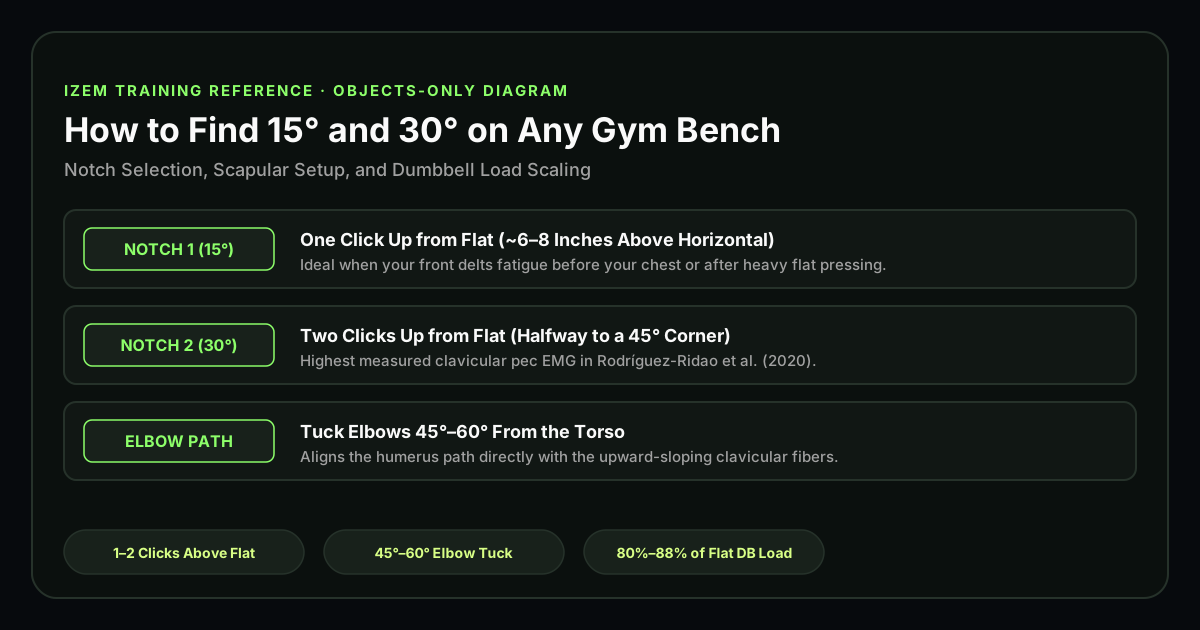
- The 1-to-2 click rule: Lay the bench completely flat (0°). Lift the backrest until it drops into the very first slot. On 90% of commercial benches (Rogue, Life Fitness, Hammer Strength, Rep), Notch 1 is 15° and Notch 2 is 30°.
- The halfway-to-45° visual check: Everyone can picture a 90° upright seat and a 45° diagonal halfway mark. A 30° incline sits noticeably below that 45° diagonal—roughly one-third of the way from flat to upright.
- The iPhone Measure app check: Open the built-in Level tool in your phone's Measure app and lay the long edge of your phone against the backrest pad. It takes five seconds once and tells you the exact angle of Notch 1 and Notch 2 on your gym's benches.
Why a Huge Arch Turns a 30° Incline Back Into a Flat Press
Selecting the 30° notch only works if your ribcage stays near 30°. When you try to move too much weight and bridge your thoracic spine hard off the pad, your sternum tilts back toward horizontal. You have effectively turned a 30° incline press back into a decline or flat press with a shorter range of motion.
- Keep your upper back and glutes glued to the pad: Retract and slightly depress your shoulder blades for stability, but avoid an exaggerated powerlifting ribcage flare.
- Raise the seat pad 1 notch: Tilting the bottom seat pad up by 10°–15° stops your hips from sliding down the bench so you don't have to arch excessively to stay anchored.
- Tuck your elbows 45° to 60°: Flaring your elbows out to 90° crowds the subacromial space and stresses the anterior shoulder capsule. Tucking your elbows slightly in front of the shoulder line matches the upward-and-inward orientation of the clavicular pec fibers (Schoenfeld et al., 2021).
- Lower the dumbbells to the outer clavicle: Aim the inner plates of the dumbbells toward your upper chest/collarbone line, pause for half a second in the stretch, and press up without clanking the dumbbells together at the top.
Should You Use 15°, 30°, or Both in Your Program?
You do not have to pick one angle forever. In fact, rotating or pairing 15° and 30° across an upper/lower split or push/pull/legs routine gives you complete chest coverage:
- Use 15° (Notch 1) as your primary heavy press: Because 15° recruits both the sternal and clavicular heads heavily while allowing 90%–95% of your flat dumbbell load, it can replace flat bench entirely if flat pressing irritates your shoulders.
- Use 30° (Notch 2) as your dedicated upper-chest builder: When you already perform a flat barbell bench press (calculated via our 1RM calculator), follow it with 3 sets of 8–12 reps on the 30° incline dumbbell press leaving 1–2 reps in reserve.
Frequently Asked Questions
Is 30° or 45° better for the incline dumbbell press?
30° is better for targeting the upper chest. Surface EMG studies show clavicular pectoralis major activation peaks at 30°, whereas 45° significantly increases anterior deltoid involvement and reduces chest activation.
How much less weight do you lift on incline dumbbell press compared to flat?
On a 15° low incline, most lifters handle 90% to 95% of their flat dumbbell press weight for the same reps. On a 30° incline, expect to use roughly 82% to 88% of your flat dumbbell weight when fresh, or 75% to 80% if performed second after flat bench.
Should dumbbells touch at the top of an incline press?
No. Clanking the dumbbells together at the top often causes you to protract your shoulder blades and lose upper-back tension, and gravity pulls straight down at lockout where there is zero horizontal adduction resistance.
References & Peer-Reviewed Evidence
- Rodríguez-Ridao D, Antequera-Vique JA, Martín-Fuentes I, Muyor JM. Effect of Five Bench Inclinations on the Electromyographic Activity of the Pectoralis Major, Anterior Deltoid, and Triceps Brachii during the Bench Press Exercise. Int J Environ Res Public Health. 2020;17(19):7339. PMC7400894.
- Lauver JD, Cayot TE, Scheuermann BW. Influence of bench angle on upper extremity muscular activation during bench press exercise. Eur J Sport Sci. 2016;16(3):309-316. PubMed 25799093.
- Chaves SFN, et al. Effects of horizontal and incline bench press on isometric strength and muscle hypertrophy. Int J Exerc Sci. 2020;13(6):859-872. PMC7449336.