Watch the video guide
A short IZEM video guide for the decisions in this article.
Core mechanical difference: The conventional deadlift begins on the floor with bent knees and uses leg drive plus hip extension to break inertia. The Romanian deadlift (RDL) begins from the top lockout with a slight, fixed 15° to 20° knee bend, lowering only until backward hip travel ends (usually mid-shin) so the hamstrings stay under continuous stretched tension [1] [2].
Educational fitness and nutrition information for healthy adults. Nothing on this page is medical advice or a clinical prescription. Stop any movement that causes sharp pain or dizziness, and consult a physician, physical therapist, or registered dietitian for medical or injury guidance.
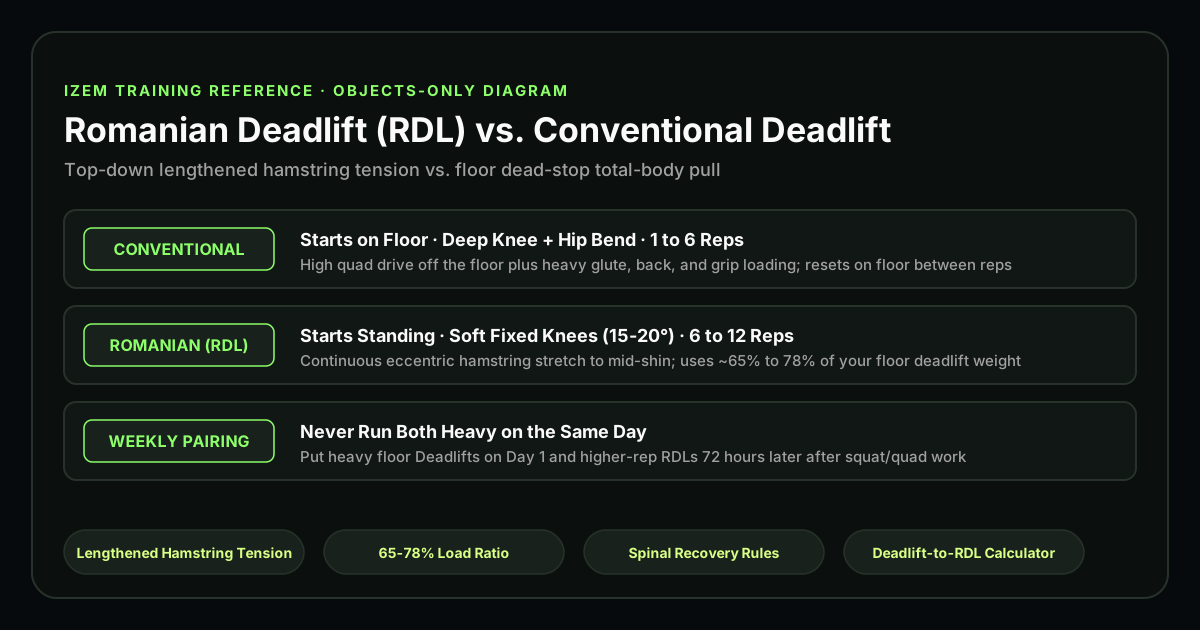
Romanian deadlift vs. conventional deadlift comparison table
Electromyography (EMG) and biomechanical analyses show that removing the floor reset and restricting knee flexion shifts workload away from the quadriceps and concentrates mechanical tension in the hamstrings (biceps femoris, semitendinosus, and semimembranosus) and gluteus maximus [1] [2].
| Feature | Conventional Deadlift | Romanian Deadlift (RDL) |
|---|---|---|
| Starting position | Dead stop on the floor (concentric first) | Standing lockout at the hips (eccentric lowering first) |
| Knee angle | 60° to 75° knee bend at setup to reach the bar | Soft, fixed 15° to 20° knee bend throughout the set |
| Bottom endpoint | Plates rest on the floor between every repetition | Mid-shin (stops the moment hips stop moving backward) |
| Hamstring stretch | Moderate (flexed knees shorten the distal hamstrings at the floor) | High (long muscle length under heavy eccentric load) [3] |
| Quadriceps involvement | High (drives the bar from the floor to the knees) [1] | Minimal (knees do not actively extend to lift the weight) |
| Typical working load | 100% baseline (typically 3 to 6 reps) | 65% to 78% of conventional deadlift (typically 8 to 12 reps) |
| Dumbbell compatibility | Awkward with heavy dumbbells due to low floor reach | Excellent (dumbbells glide down the front/sides of thighs) |
Interactive Deadlift-to-RDL Working Weight Calculator
Enter either your conventional deadlift working weight or your RDL working weight, along with your equipment choice, to estimate your matching load across both variations.
Estimated Posterior-Chain Working Loads
Why the RDL builds hamstrings faster per unit of lower-back fatigue
Because the hamstrings cross both the hip and knee joints, bending your knees deeply at the bottom of a conventional deadlift slackens the lower end of the hamstrings while the hips flex. In an RDL, keeping your knees nearly fixed while pushing your hips straight back Toward the wall behind you stretches the hamstrings across a long muscle length under load [2].
Controlled hypertrophy studies show that training muscles at longer muscle lengths (such as the stretched bottom of an RDL or seated leg curl) stimulates strong regional muscle growth [3]. Better yet, because an RDL uses roughly 70% of your floor deadlift weight for sets of 8 to 10 reps, it places less peak compressive shear on the lumbar spine.
How to program both lifts in the same week
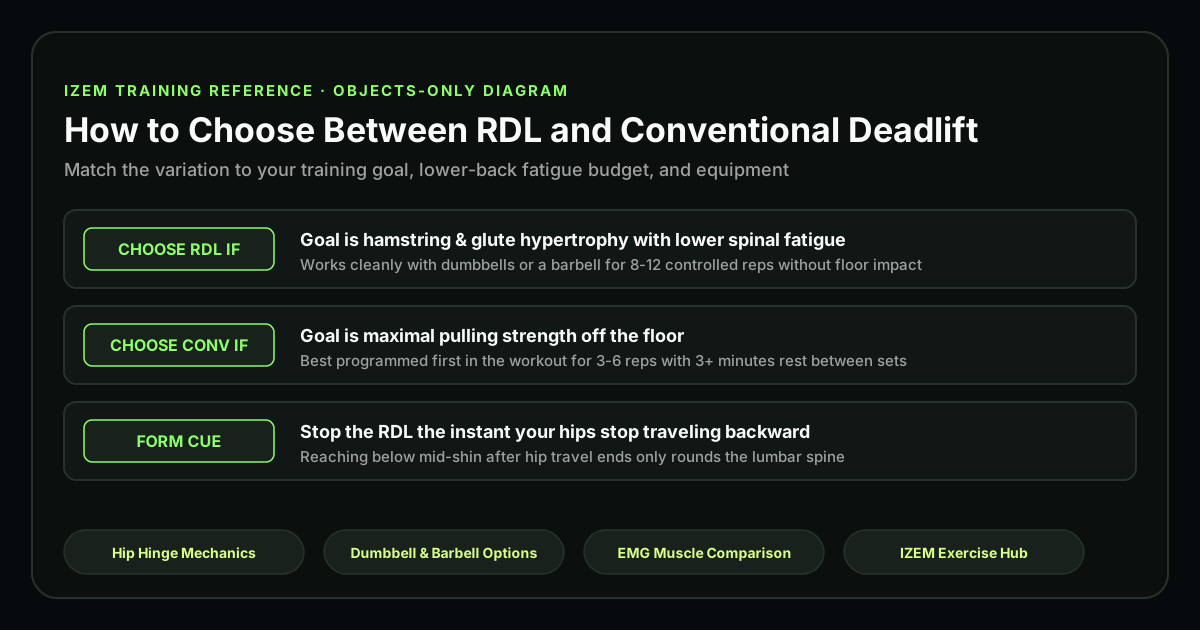
- On a 4-day Upper/Lower split: Place Barbell Squats + Dumbbell or Barbell RDLs (3 × 8 to 10) on Tuesday (Lower A), and place Conventional or Trap-Bar Deadlifts (3 × 5) on Friday (Lower B) when your lower back has had 72 hours of recovery.
- The mid-shin stop rule on RDLs: Never judge an RDL by whether the plates touch the floor. Lower the bar only as far as your hips can travel backward with a neutral spine. The instant your hips stop moving back, any extra inch toward the floor comes from rounding your lower back.
Looking for machine or home swaps when the barbell platform is busy? Open our Exercise Substitution Chart or check your 1RM percentages in the 1RM Calculator.
Frequently asked questions
Can I replace conventional deadlifts with Romanian deadlifts permanently?
Unless you compete in powerlifting or strongman, yes. You do not have to pull from the floor to build a strong back, glutes, and hamstrings. Pairing squats or leg presses with RDLs covers both knee extension and hip extension thoroughly.
How much weight should I use on Dumbbell RDLs compared to Barbell RDLs?
Because each hand holds an independent dumbbell and grip fatigue accumulates over 8 to 12 continuous reps, most lifters start with roughly 40% to 45% of their Barbell RDL total weight in each hand (80% to 90% combined).
Are lifting straps okay to use on Romanian deadlifts?
Yes. On sets of 8 to 12 continuous RDLs where the bar never rests on the floor, forearm grip often gives out long before your hamstrings and glutes reach 1 to 2 RIR. Using straps on your heaviest working sets prevents grip from bottlenecking leg growth.
References and primary sources
- Martín-Fuentes I, Oliva-Lozano JM, Muyor JM. Electromyographic activity in deadlift exercise and its variants. A systematic review. PLoS One. 2020;15(2):e0229507. PubMed 32106251.
- McAllister MJ, Hammond KG, Schilling BK, Ferreria LC, Reed JP, Weiss LW. Muscle activation during various hamstring exercises. Journal of Strength and Conditioning Research. 2014;28(6):1573-1580. PubMed 24149748.
- Maeo S, Meng H, Yuhashi W, et al. Greater Hamstrings Muscle Hypertrophy but Similar Damage Protection after Training at Long versus Short Muscle Lengths. Medicine & Science in Sports & Exercise. 2021;53(4):825-837. PubMed 33009197.