Watch the video guide
A short IZEM video guide for the decisions in this article.
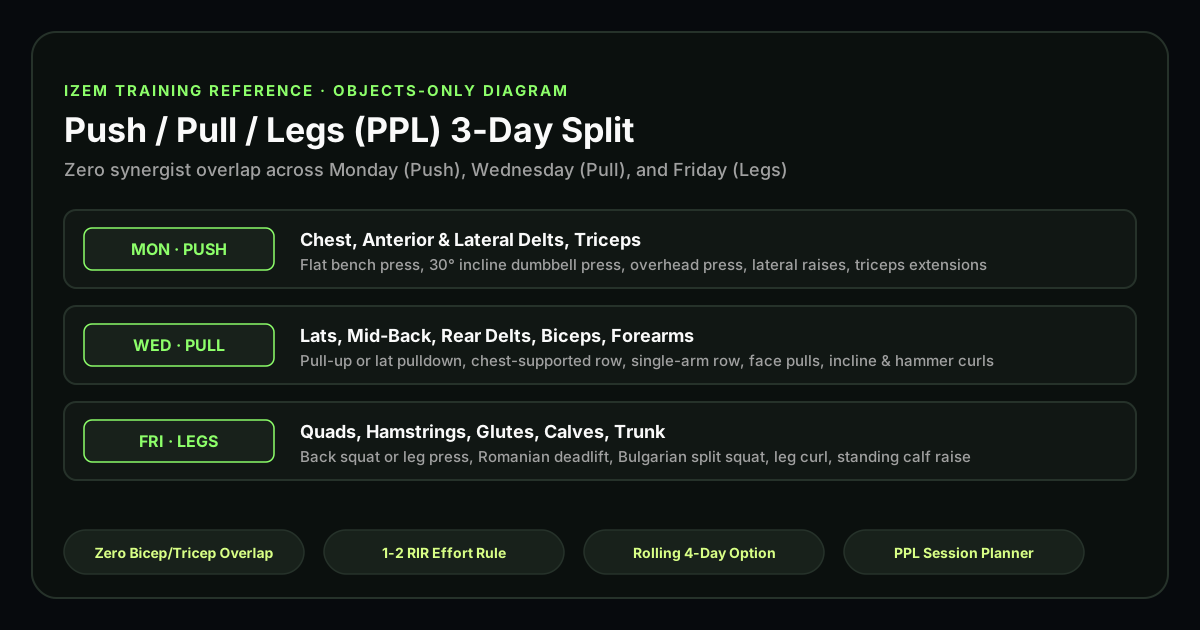
How 3-day PPL works: You train three non-consecutive days per week—Push (chest, shoulders, triceps), Pull (back, rear delts, biceps), and Legs (quads, hamstrings, glutes, calves). Because each workout happens once every seven days, working sets must be taken within 1 to 2 Reps in Reserve (RIR) with 9 to 12 weekly sets per muscle group [1] [2].
Educational fitness and nutrition information for healthy adults. Nothing on this page is medical advice or a clinical prescription. Stop any movement that causes sharp pain or dizziness, and consult a physician, physical therapist, or registered dietitian for medical or injury guidance.
Complete 3-day Push / Pull / Legs workout tables
In a 3-day PPL routine, you have a full rest day after every session. That allows you to place two multi-joint presses on Push day, two heavy pulls on Pull day, and both a squat and hip hinge on Leg day without carrying fatigue into tomorrow's workout.
| Day & Movement | Exercise | Sets × Reps | Rest | Primary Target |
|---|---|---|---|---|
| Push · 1 | Barbell or Flat Dumbbell Bench Press | 3 × 6 to 8 | 2.5-3 min | Mid/lower chest, front delts, triceps |
| Push · 2 | 30° Incline Dumbbell Press | 3 × 8 to 10 | 2 min | Upper (clavicular) chest |
| Push · 3 | Seated or Standing Overhead Shoulder Press | 3 × 8 to 10 | 2 min | Anterior and lateral deltoids |
| Push · 4 | Dumbbell or Cable Lateral Raise | 3 × 12 to 15 | 60-75 sec | Lateral deltoids |
| Push · 5 | Overhead Triceps Extension + Rope Pressdown | 3 × 10 to 12 | 60-75 sec | Triceps long and lateral heads |
| Pull · 1 | Pull-Up or Wide/Neutral Lat Pulldown | 3 × 6 to 10 | 2-2.5 min | Latissimus dorsi, teres major |
| Pull · 2 | Chest-Supported Row or Barbell Row | 3 × 8 to 10 | 2 min | Mid-back, rhomboids, lats |
| Pull · 3 | One-Arm Dumbbell Row or Seated Cable Row | 3 × 10 to 12 | 90 sec | Lower lats and upper back |
| Pull · 4 | Rope Face Pull or Rear-Delt Fly | 3 × 12 to 15 | 60 sec | Posterior deltoids, external rotators |
| Pull · 5 | Incline Dumbbell Curl + Hammer Curl | 3 × 10 to 12 | 60 sec | Biceps long head, brachialis |
| Legs · 1 | Barbell Back Squat, Hack Squat, or Leg Press | 3 × 6 to 8 | 3 min | Quadriceps, glutes |
| Legs · 2 | Barbell or Dumbbell Romanian Deadlift (RDL) | 3 × 8 to 10 | 2.5 min | Hamstrings, glutes, spinal erectors |
| Legs · 3 | Dumbbell Bulgarian Split Squat | 3 × 8 to 10 / leg | 90 sec | Quads, glutes, hip stabilizers |
| Legs · 4 | Seated or Lying Hamstring Curl | 3 × 10 to 15 | 75 sec | Knee-flexion hamstrings |
| Legs · 5 | Standing Calf Raise + Hanging Leg Raise | 3 × 12 to 15 | 60 sec | Gastrocnemius, soleus, abs |
The honest limitation of 3-day PPL (and how to fix it)
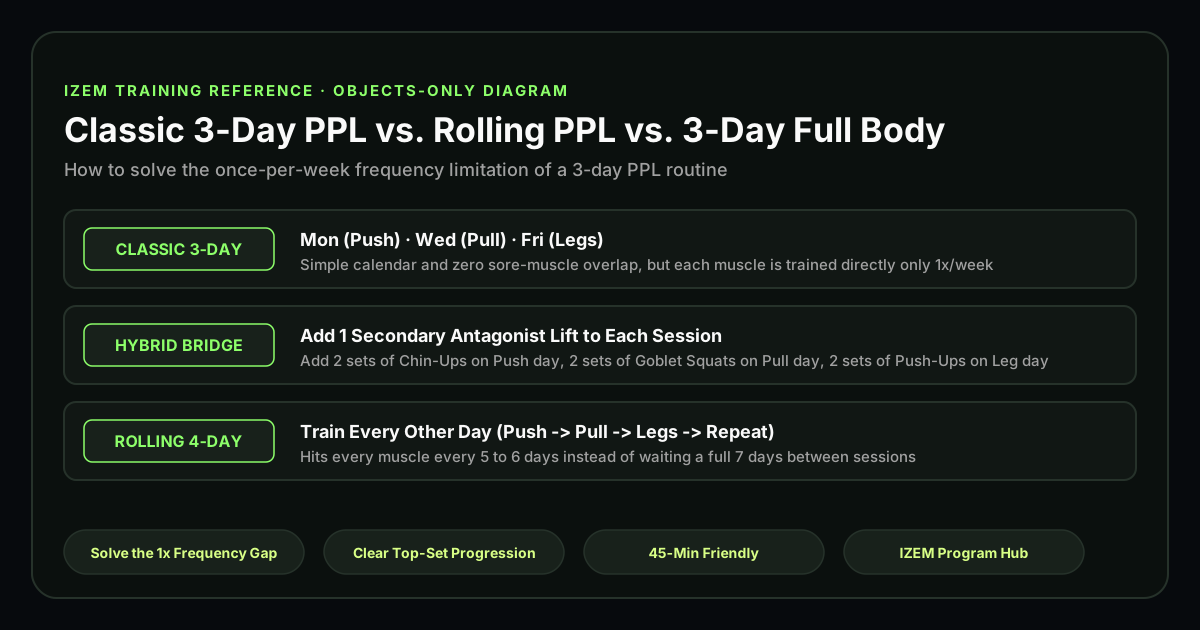
Originally, Push/Pull/Legs was designed to run twice across six days (Push, Pull, Legs, Push, Pull, Legs, Rest). When you run it on Monday, Wednesday, and Friday, each muscle group waits seven full days before it gets trained again. Resistance-training meta-analyses show that hitting a muscle twice per week outperforms once-weekly training when total sets aren't equated—and makes it easier to perform high-quality sets before fatigue sets in [1].
If you only have three gym days per week, you have two ways to keep PPL effective:
- The Micro-Bridge Option (stay on 3 days/week): Add one 3-set touch-up movement at the end of each day for a lagging muscle group—for example, 3 sets of Chin-Ups at the end of Push day, 3 sets of Goblet or Split Squats at the end of Pull day, and 3 sets of Incline Dumbbell Presses or Push-Ups at the end of Leg day. That gives chest, back, and quads a second weekly stimulus in five extra minutes.
- The Rolling Every-Other-Day PPL (3.5 days/week): Train Monday, Wednesday, Friday, Sunday, Tuesday, Thursday, Saturday. Each muscle is trained once every 6 days instead of every 7 days.
Interactive 3-Day PPL Frequency & Equipment Planner
Select your PPL style and equipment access to generate a copyable Monday/Wednesday/Friday workout sheet.
3-Day PPL Routine
Want to swap any of the barbell or cable movements above for home equipment? Open the Exercise Substitution Library or build a custom schedule in the Free Workout Plan Generator.
Frequently asked questions
Can beginners build muscle on a 3-day Push Pull Legs split?
Yes. As long as total weekly volume reaches roughly 9 to 12 hard sets per major muscle group (taken within 1 to 2 RIR) and you progressively add repetitions or weight over time, a 3-day PPL split builds both strength and muscle.
Should I put deadlifts on Pull day or Leg day in a 3-day PPL?
In a Monday/Wednesday/Friday PPL schedule, putting Romanian Deadlifts on Friday (Leg day) and keeping Wednesday (Pull day) focused on vertical pulls and chest-supported rows prevents your lower back from getting taxed twice in 48 hours.
What if I miss Friday's Leg day on a 3-day PPL?
Start next Monday with Legs, then run Push on Wednesday and Pull on Friday. Rotating the three workouts in order prevents your lower body from going two full weeks without training.
References and primary sources
- Schoenfeld BJ, Ogborn D, Krieger JW. Effects of Resistance Training Frequency on Measures of Muscle Hypertrophy: A Systematic Review and Meta-Analysis. Sports Medicine. 2016;46(11):1689-1697. PubMed 27102172.
- Schoenfeld BJ, Ogborn D, Krieger JW. Dose-response relationship between weekly resistance training volume and increases in muscle mass: A systematic review and meta-analysis. Journal of Sports Sciences. 2017;35(11):1073-1082. PubMed 27433992.
- Iversen VM, Norum M, Schoenfeld BJ, Fimland MS. No Time to Lift? Designing Time-Efficient Training Programs for Strength and Hypertrophy: A Narrative Review. Sports Medicine. 2021;51(10):2079-2095. PubMed 34125411.